Was When Free Range Beef Invented
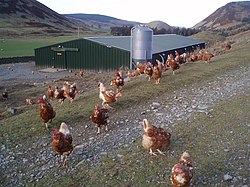


A small flock of mixed complimentary-range chickens being fed outdoors
Free range denotes a method of farming husbandry where the animals, for at least office of the day, can roam freely outdoors, rather than beingness bars in an enclosure for 24 hours each day.[1] On many farms, the outdoors ranging area is fenced, thereby technically making this an enclosure, however, free range systems unremarkably offer the opportunity for the extensive locomotion and sunlight that is otherwise prevented past indoor housing systems. Gratuitous range may apply to meat, eggs or dairy farming.
The term is used in ii senses that exercise non overlap completely: as a farmer-centric clarification of husbandry methods, and as a consumer-centric description of them. There is a diet where the practitioner only eats meat from free-range sources called upstanding omnivorism.
In ranching, free-range livestock are permitted to roam without being fenced in, as opposed to intensive brute farming practices such as the concentrated creature feeding functioning. In many agriculture-based economies, gratis-range livestock are quite mutual.
History [edit]

Costless range ducks in Hainan Province, China
If one allows "gratuitous range" to include "herding", free range was a typical husbandry method at to the lowest degree until the development of barbed wire and chicken wire. The more often than not poor understanding of nutrition and diseases before the twentieth century fabricated information technology difficult to raise many livestock species without giving them access to a varied nutrition, and the labor of keeping livestock in solitude and carrying all their feed to them was prohibitive except for loftier-profit animals such every bit dairy cattle.
In the instance of poultry, complimentary range was the dominant system until the discovery of vitamins A and D in the 1920s, which allowed confinement to be practised successfully on a commercial scale. Before that, green feed and sunshine (for the vitamin D) were necessary to provide the necessary vitamin content.[ii] Some big commercial breeding flocks were reared on pasture into the 1950s. Nutritional science resulted in the increased use of confinement for other livestock species in much the same way.
United States [edit]
In the United States, the USDA free range regulations currently apply simply to poultry and indicate that the animate being has been allowed access to the outside.[3] The USDA regulations do not specify the quality or size of the exterior range nor the duration of time an animal must have admission to the outside.[four] The Certified Humane Programme offers third-party certification for producers who encounter minimum standards, including providing access to grass pastures, traditional nests, and "dust areas to perform natural behaviors".[v]
The term "free range" is mainly used as a marketing term rather than a husbandry term, meaning something on the gild of, "low stocking density", "pasture-raised", "grass-fed", "old-fashioned", "humanely raised", etc.
There have been proposals to regulate USDA labeling of products as complimentary range within the Usa. As of 2017[update] what constitutes raising an animal "free range" is nearly entirely decided past the producer of that product, and is frequently inconsistent with consumer ideas of what the term means.
Complimentary-range poultry [edit]

Gratuitous range meat chickens seek shade on a U.Due south. farm.
In poultry-keeping, "free range" is widely confused with yarding, which ways keeping poultry in fenced yards. Yarding, as well every bit floorless portable chicken pens ("chicken tractors") may have some of the benefits of gratis-range livestock only, in reality, the methods accept little in mutual with the costless-range method.
A behavioral definition of free range is peradventure the most useful: "chickens kept with a fence that restricts their movements very footling."[ citation needed ] This has practical implications. For example, according to Jull, "The most effective measure of preventing cannibalism seems to be to give the birds expert grass range."[6] De-beaking was invented to prevent cannibalism for birds non on free range, and the need for de-beaking tin exist seen every bit a litmus test for whether the chickens' environment is sufficiently "free-range-like".[7] [ citation needed ]
The U.S. Department of Agriculture Food Rubber and Inspection Service (FSIS) requires that chickens raised for their meat have access to the outside in order to receive the free-range certification.[8] There is no requirement for admission to pasture, and there may be access to only dirt or gravel. Gratuitous-range chicken eggs, however, have no legal definition in the United States. Likewise, complimentary-range egg producers accept no common standard on what the term means.
The broadness of "gratuitous range" in the U.South. has acquired some people to look for alternative terms. "Pastured poultry" is a term promoted by farmer/author Joel Salatin for broiler chickens raised on grass pasture for all of their lives except for the initial brooding period. The Pastured Poultry concept is promoted by the American Pastured Poultry Producers' Clan (APPPA),[9] an organisation of farmers raising their poultry using Salatin'due south principles.
Free-range livestock [edit]
Traditional American usage equates "free range" with "unfenced", and with the implication that there was no herdsman keeping them together or managing them in any style. Legally, a costless-range jurisdiction allowed livestock (possibly only of a few named species) to run free, and the possessor was not liable for whatever damage they acquired. In such jurisdictions, people who wished to avert harm by livestock had to debate them out; in others, the owners had to fence them in.[x]
The USDA has no specific definition for "free-range" beef, pork, and other non-poultry products. All USDA definitions of "free-range" refer specifically to poultry.[11]
In a December 2002 Federal Register notice and asking for comments (67 Fed. Reg. 79552), USDA's Agricultural Marketing Service proposed "minimum requirements for livestock and meat industry production/marketing claims".[12] Many industry claim categories are included in the notice, including breed claims, antibiotic claims, and grain fed claims. "Free Range, Free Roaming, or Pasture Raised" would be defined equally "livestock that have had continuous and unconfined admission to pasture throughout their life bike" with an exception for swine ("continuous access to pasture for at least fourscore% of their production cycle"). In a May 2006 Federal Register discover (71 Fed. Reg. 27662), the agency presented a summary and its responses to comments received in the 2002 notice, just merely for the category "grass (fodder) fed" which the agency stated was to be a category carve up from "free range".[xiii] Comments received for other categories, including "costless range", are to be published in future Federal Register editions.
European Union [edit]

The European Wedlock regulates marketing standards for egg farming which specifies the following (cumulative) minimum conditions for the complimentary-range method:
- hens take continuous daytime admission to open-air runs, except in the case of temporary restrictions imposed by veterinarian authorities,
- the open-air runs to which hens have access is mainly covered with vegetation and not used for other purposes except for orchards, woodland and livestock grazing if the latter is authorised by the competent authorities,
- the open-air runs must at least satisfy the conditions specified in Article 4(one)(3)(b)(two) of Directive 1999/74/EC whereby the maximum stocking density is not greater than 2500 hens per hectare of basis available to the hens or one hen per 4 mtwo at all times and the runs are not extending beyond a radius of 150 m from the nearest pophole of the edifice; an extension of up to 350 1000 from the nearest pophole of the building is permissible provided that a sufficient number of shelters and drinking troughs within the pregnant of that provision are evenly distributed throughout the whole open-air run with at to the lowest degree four shelters per hectare.[xiv]

Costless range geese in Germany
Otherwise, egg farming in Eu is classified into four categories: Organic (ecological), Gratuitous Range, Befouled, and Cages.[15]) The mandatory labelling on the egg shells attributes a number (which is the kickoff digit on the characterization) to each of these categories: 0 for Organic, 1 for Gratuitous Range, 2 for Befouled and 3 for Cages.[sixteen]
At that place are EU regulations near what free-range means for laying hens and broilers (meat chickens) as indicated above. However, there are no European union regulations for free-range pork, so pigs could be indoors for some of their lives. In society to be classified as costless-range, animals must accept admission to the outdoors for at least part of their lives.[17]
United kingdom [edit]

Free range pigs in England
Pigs: Free-range pregnant sows are kept in groups and they are often provided with straw for bedding, rooting and chewing. Effectually 40% of United kingdom of great britain and northern ireland sows are kept gratuitous-range outdoors and farrow in huts on their range.[18]
Egg laying hens: Cage-gratuitous egg product includes barn, costless-range and organic systems. In the United kingdom of great britain and northern ireland, free-range systems are the about popular of the non-cage alternatives, accounting for effectually 57% of all eggs, compared to 2% in barns and 2% organic. In free-range systems, hens are housed to a similar standard as the barn or aviary.[19]
Free-range rearing of pullets: Free range rearing of pullets for egg-laying is now existence pioneered in the UK by various poultry rearing farms. In these systems, the pullets are allowed outside from as young every bit 4 weeks of age, rather than the conventional systems where the pullets are reared in barns and allowed out at 16 weeks of age
Meat chickens: Free-range broilers are reared for meat and are immune access to an outdoor range for at least viii hours each twenty-four hour period. RSPCA standards state that in order for chickens to be free range, there must non be more than than 13 chickens per square meter.[twenty] Free-range broiler systems use slower-growing breeds of craven to improve welfare, meaning they reach slaughter weight at 16 weeks of age rather than 5–6 weeks of historic period in standard rearing systems.
Turkeys: Complimentary-range turkeys have continuous access to an outdoor range during the daytime. The range should be largely covered in vegetation and allow more than space. Access to fresh air and daylight means ameliorate eye and respiratory health. The turkeys are able to exercise and exhibit natural behaviour resulting in stronger, healthier legs. Free-range systems oftentimes use slower-growing breeds of turkey.[21]
Costless range dairy: In recent years[ when? ] the free range dairy scheme has become more prevalent. Farms supplying milk under the free range dairy make abide by the pasture promise, meaning the cows will accept access to pasture state to graze for a minimum of 180 days and nights a twelvemonth. There is evidence to suggest that milk from grass contains higher levels of fats such as omega-3 and conjugated linoleic acid (CLA). Additionally costless range dairy is giving consumers more choice as to where their milk comes from. Complimentary range dairy provides the consumer with reassurance that the milk they drink has come from cows with the freedom to roam and can graze in their natural habitat.
Australia [edit]
Australian standards in relation to free-range production are largely consort in tertiary-party certification trade marks due to the absence of whatsoever meaning legally bounden legislation. A number of certification bodies are utilised by rearers to identify their products with a item level of animal welfare standards. In events where producers practise not choose to use a certified trade marking and merely land that their production is 'costless range', the producer is bound past consumer expectations and perceptions of what constitutes gratuitous range.[22] Producers are by and large thought to exist bound to Model Codes of Practice of Creature Welfare published by the CSIRO, and in some states this forms part of legislation.
Egg laying hens [edit]
In Commonwealth of australia, iii farming methods for the production of eggs are utilised. In 2011, traditional cage (or battery) eggs accounted for 42% of value, barn-laid eggs account for 10% of value, free-range eggs deemed for 44% of value, and organic eggs accounted for 4% of value.[23] Increased demand for complimentary range eggs due to customer concerns over animal welfare has led to a number of different standards developing in relation to 3 core welfare measures – indoor stocking density, outdoor stocking density, and beak trimming. The Model Lawmaking of Do recommends practices for gratuitous range farming with the post-obit standards:[24]
- Maximum stocking densities indoors of 30 kg/mtwo, equivalent to about xiv–15 birds per square metre.
- Maximum outdoor stocking density of 1500 birds per hectare, although this tin can exist increased with rotation onto fresh pasture
- Access to the outdoor range for a minimum of 8 hours per day, except in agin atmospheric condition weather
- two metres worth of popholes per one,000 birds for admission to the range
- Beak trimming is permitted, and to be undertaken by an accredited operator
The above standards are not ever met, and on some occasions producers may desire more ethical standards. Equally such, certified merchandise marks play a pregnant role in the determining of what constitutes free range. The key certifications used for layer hens in Australia include the following:
Egg Corp Assured is the weakest standard, fix by the industry superlative grouping and largely based on the Model Code of Practice. Egg Corp Assured differs in that it interprets the outdoor stocking density figure equally largely irrelevant to welfare. Egg Corp Assured has been known to certify farms running up to 44,000 birds per hectare outdoors, far in excess of recommendations.[25] Like the Model Lawmaking of practice, beak trimming is immune and indoor densities sew together to 15 birds per square metre.
RSPCA Approved Farming is a standard that can be applied to both befouled-laid and free-range egg producers. Farms using this certification must take an indoor density of 9 birds per square metre indoors on slats, or 7 birds per foursquare metre indoors in a deep-litter system. The standards dictate a maximum outdoor density of 1500 per hectare without rotation, or 2500 birds per hectare with rotation, and beak trimming is allowed.[26]
Free Range Egg & Poultry Australia (FREPA) standards provides a sliding scale for indoor density, with ten birds per square metreallowed only in enclosures housing less than one thousand birds, and half dozen birds per foursquare metrethe maximum for barns with over 4000 birds. Zip is said in the standards most outdoor density, thus it is assumed that farmers must meet the standards under the Model Lawmaking. Beak trimming is allowed nether this certification.[27]
Humane Choice Truthful Complimentary Range standards are some of the most sound as far as creature welfare is concerned. Neb trimming or whatever other mutilation is not permitted, perches must be provided, and maximum flock numbers cannot be greater than 2500 per barn. The outdoor stocking density is 1500 birds per hectare, and the indoor density is 5 birds per foursquare metre.[28]
Australian Certified Organic Standards include criteria on feed content and the use of pesticides in addition to fauna welfare requirements. The indoor density is a maximum of 8 birds per square metre, although about operators under this standard listing their density as 5 birds per square metre. The outdoor density is 1000 birds per hectare, and nib trimming is not permitted.
Chicken meat [edit]
In Commonwealth of australia, free range and organic craven accounts for about 16.6% of value in the poultry marketplace. This percentage is expected to grow to up to 25% in the adjacent 5 years. No meat birds are raised in cages in Australia.[23] In that location are three main certification trademarks in this market.
Free Range Egg & Poultry Australia (FREPA) standards are those in which most supermarket brands of free range chicken meat are accredited under. These standards require indoor stocking densities of up to 30 kg/m2 indoors (virtually 15 birds per square metre), and beak trimming is not permitted. Outdoor stocking density is not stated, only it is understood that the outdoor range must exist at a minimum 1.5 times the floor area of inside the befouled.[29]
RSPCA Approved Farming standards for costless range require an indoor stocking density of about 17 birds per square metre, and outdoor densities of up to 17 birds per square metre. No bill trimming is allowed under this system.
Australian Certified Organic standards dictate a maximum indoor stocking density of up to 12 birds per square metre indoors, and 2500 birds per hectare outdoors. These standards require perches, and foreclose large, conventional broiler sheds.
See likewise [edit]
 | Wikimedia Commons has media related to Gratuitous range. |
- Ethical consumerism
- Complimentary-range eggs
- Grass-fed beef
- Organic eggs
- Chickens as pets
- Grazing
- Upstanding omnivorism
- Yarding
References [edit]
- ^ "Lexicon definition". Retrieved three November 2012.
- ^ Heuser, G. F: "Feeding Poultry", folio xi. Norton Creek Press, 2003.
- ^ "USDA Fact Sheet: Meat and Poultry Labeling Terms".
- ^ Egg Carton Labels: A brief guide to labels and beast welfare The Humane Society of the United states. Updated March 2009.
- ^ "Farm Creature Welfare Certification Guide". Vermont Police School . Retrieved 23 September 2021.
- ^ Jull, Morley A. (1938). Poultry Husbandry. McGraw Hill. pp. 346–347.
- ^ Chamberlain, Gethin (26 March 2016). "Horrifying truth of the brutal life of free range hens laid bare". mirror . Retrieved viii Dec 2021.
- ^ "Meat and Poultry Labeling Terms". Fact Sheets. USDA. Retrieved 22 Jan 2014.
- ^ "Getting Started". American Pastured Poultry Producers' Association. Retrieved 8 January 2013.
- ^ "Department of Animal and Veterinary Sciences". world wide web.uvm.edu.
- ^ "Meat and Poultry Labeling Terms". Fact Sheets. USDA. Archived from the original on half dozen January 2013. Retrieved eight January 2013.
- ^ "The states Standards for Livestock and Meat Marketing Claims". Federal Register. USDA. 30 December 2002. Retrieved 8 Jan 2013.
- ^ "Archived copy". Archived from the original on 6 Dec 2006. Retrieved 4 January 2007.
{{cite spider web}}: CS1 maint: archived copy as championship (link) - ^ Committee Regulation for marketing standards for eggs - page 25
- ^ Steiner, Zvonimir; Šperanda, Marcela; Domačinović, Matija; Antunović, Zvonko; Senčić, Đuro (10 July 2006). "Egg quality from complimentary range and cage system of keeping layers". Stockbreeding : Journal of Animal Improvement. 60 (3): 173–179 – via Hrčak.
- ^ "Commission directive on the registration of establishments keeping laying hens - page iv".
- ^ "Know your labels". www.ciwf.org.britain.
- ^ "Pity in World Farming - Pigs - Higher welfare alternatives". ciwf.org.uk.
- ^ "Pity in World Farming - Egg laying hens - Higher welfare alternatives". ciwf.org.uk.
- ^ Rebecca Nicholson (18 August 2018). "What does 'free-range' actually hateful? It'southward complicated". The Guardian. Retrieved xix Feb 2021.
- ^ "Compassion in World Farming - Turkeys - Higher welfare alternatives". ciwf.org.u.k..
- ^ Initial Findings on 20,000 birds/ha free range CTM
- ^ a b "Market Research Reports & Analysis - IBISWorld AU". www.ibisworld.com.au.
- ^ "Model Code of Practice for the Welfare of Animals: Domestic Poultry". world wide web.publish.csiro.au. CSIRO Publishing. October 2002. ISBN9780643069145.
- ^ "Table of ECA Certified farm". ecoeggs.com.au. [ dead link ]
- ^ "Layer Hens: RSPCA Approved Farming Scheme Standards" (PDF). rspcaapproved.org.au. September 2015.
- ^ Layer Standards
- ^ "Option Free Range Standards". humanechoice.com.au.
- ^ "Meat Labels".
Source: https://en.wikipedia.org/wiki/Free_range
0 Response to "Was When Free Range Beef Invented"
Post a Comment